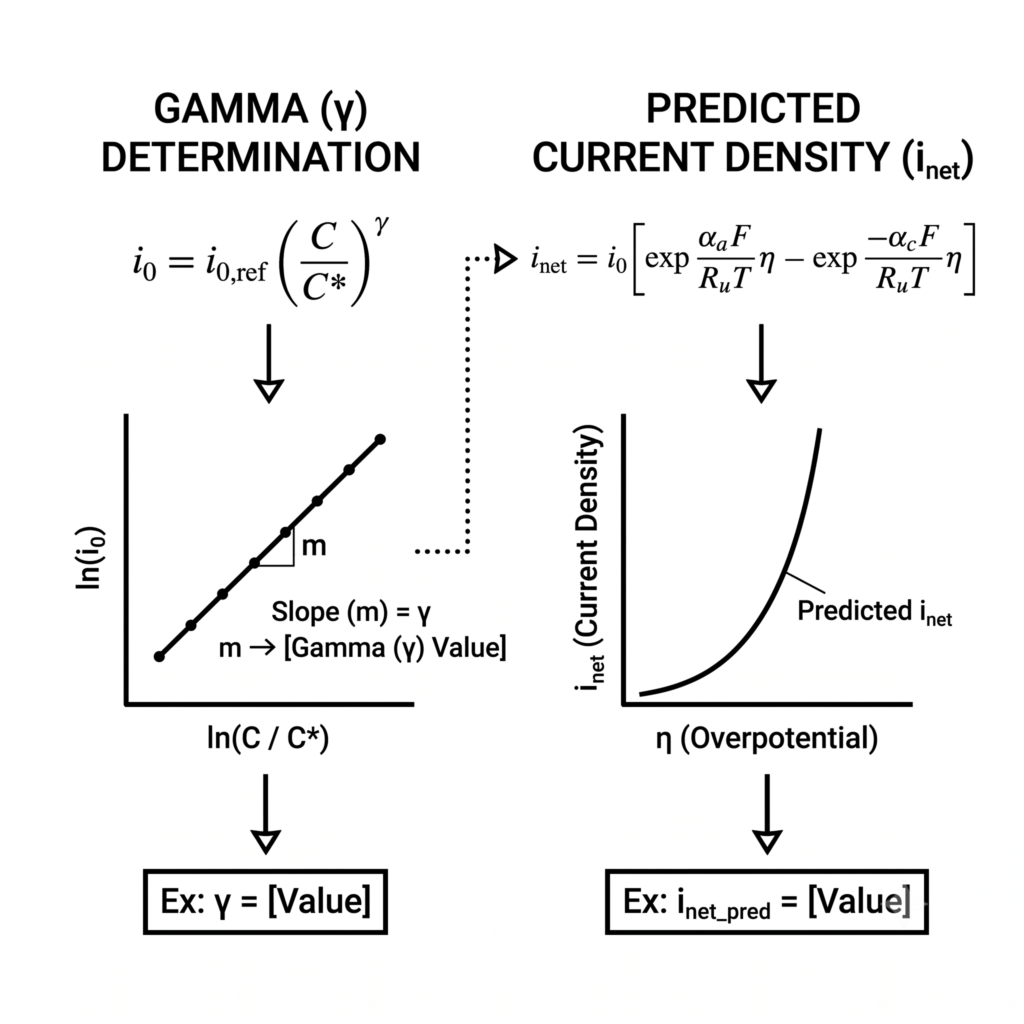
Recently, I’ve been revisiting and deriving the core electrochemical Butler-Volmer Model. After working through the equations, my attention was drawn to the dependence of the exchange current density ($i_o$) on the reactant concentration ($C$):
As soon as I saw this equation, I applied it directly to some experimental data I had on hand. The experimental data recorded two sets of measurements at 1 atm with varying oxygen concentrations:
- Under pure oxygen: measured $j_1 = 800\ mA/cm^2$
- Under air: measured $j_1 = 150\ mA/cm^2$
Using these two sets of data, I solved the simultaneous equations and obtained a reaction order of 1.04 with a reference constant of 800, which can be expressed as:
To verify whether current density variation is predictable, I used this derived mathematical model to predict the performance of pure oxygen at 1.5 atm backpressure. Using ideal gas behavior to calculate concentration and plugging in 1.5:
This calculated result is remarkably close to the actual experimental measurements. To enable rapid verification of data in everyday experiments, I developed a lightweight Reaction Order (gamma) Calculator. Feel free to click the link and try it out.
Deep Dive: The Double-Edged Sword of Gamma and Catalyst Optimization Strategies
We can go further and touch on a very deep physical essence in fuel cell design: the value of the reaction order (gamma) calculated by the tool is actually a double-edged sword.
1. A sufficiently low gamma value means: using air as the cathode gas can still maintain high current density
- If gamma = 1, when the oxygen concentration switches from 1.0 (pure oxygen) to 0.2 (air), the current density drops linearly (e.g., from 800 to 150).
- If we can optimize the catalyst to bring gamma down to around 0.5, under the same C=0.2 air environment, the current density would only gradually decline to 358. This represents a 2.3x improvement over the original air performance! Lowering the gamma value allows the cell to exhibit stronger resistance to performance drop in low-concentration environments.
2. How to reduce gamma at the materials level?
From the perspective of electrochemical adsorption theory, the magnitude of gamma may fundamentally depend on the binding energy of the catalyst surface. To lower gamma, the core approach is to reduce overly strong adsorption of products and intermediate species on the catalyst surface, preventing active sites from being poisoned and occupied.
Currently in materials engineering, three main tuning strategies are employed:
- Alloying Effect: Introduce transition metals (e.g., Pt-Co, Pt-Ni), using coordination effects to shift the d-band center of Pt and weaken adsorption of oxygen-containing intermediates.
- Core-Shell Nanostructures: Use lattice strain (strain effect) imposed by the core metal on the Pt shell to optimize surface adsorption energy.
- Facet Engineering: Precisely expose specific crystal facets with the highest ORR activity and most optimal adsorption (e.g., Pt(111)), achieving a leap in intrinsic activity.
Further Reading: Tafel Slope and Exchange Current Density i_o: From Theory to an Interactive Analysis Tool
Leave a Reply