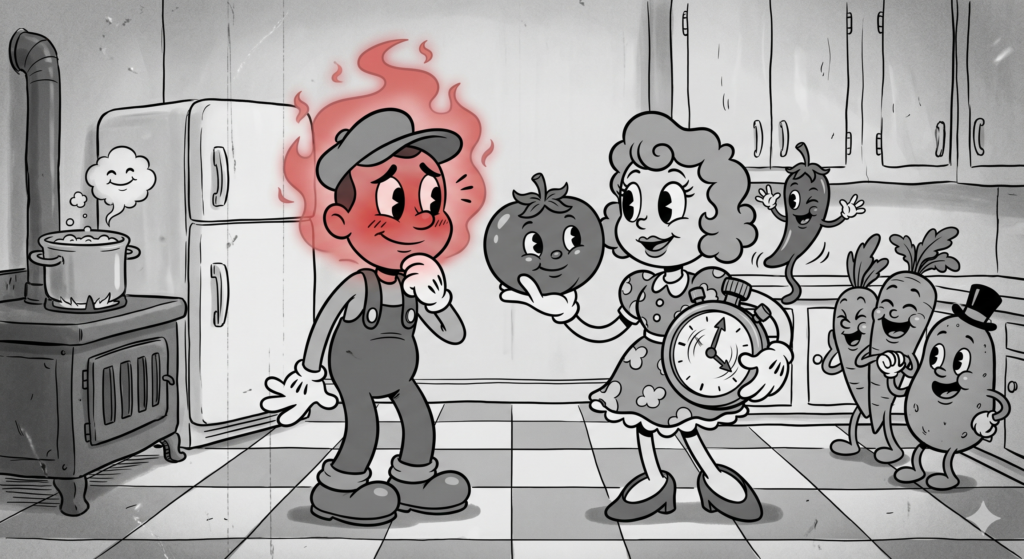
Du bist mein Typ, darum schenke ich dir meine Zeit.
Wenn ich dich sehe, wirst du rot wie eine Tomate. Ich mag es, mit dir zu quatschen. Du bist so scharf wie eine Chili! Du bist genau mein Typ, darum schenke ich dir meine Zeit. Meine Zeit ist wertvoll, und du bist es auch.
Meine Freunde fragen mich: “Warum triffst du dich mit ihr?”
Ich lächle nur und sage: “Weil sie mein Lieblingsgemüse ist.”
Du bist mein Typ, darum schenke ich dir meine Zeit.
You are my type, so I give you my time.
The second half of the sentence begins with the adverb darum (therefore/so). In German, darum occupies the first position, so the verb schenke must follow immediately (verb-second rule), with the subject ich coming after.
- mein Typ: my type (as in: you are my type / my kind of person).
- schenke… dir…: give (to) you… (infinitive: schenken; requires dative for the recipient + accusative for the thing given — so you is dir (dative) and my time is meine Zeit (accusative)).
Wenn ich dich sehe, wirst du rot wie eine Tomate.
When I see you, you turn red like a tomato.
The first half is a subordinate clause introduced by Wenn (when). The verb sehe is pushed to the very end before the comma (subordinate clause verb-final rule).
The second half is the main clause. Because a subordinate clause precedes it, the main clause verb wirst must sit immediately after the comma in first position, followed by the subject du.
- wirst: become (irregular conjugation of werden for du).
- rot wie eine Tomate: red like a tomato (feminine noun die Tomate).
Ich mag es, mit dir zu quatschen.
I like chatting with you.
This is a very idiomatic zu + infinitive construction. Ich mag es (I like it) serves as the lead-in, with a comma separating the actual action zu quatschen at the end.
- mit dir: with you (preposition mit always takes dative, so dir is used).
- quatschen: to chat, to shoot the breeze (more casual and intimate than reden or sprechen).
Du bist so scharf wie eine Chili!
You are as hot as a chili!
Pun structure: so [adjective] wie [noun] (as [adjective] as [noun]).
- scharf: spicy. In colloquial German, describing someone as scharf is like calling someone hot in English — meaning very attractive, having a great figure.
- die Chili: chili pepper.
Du bist genau mein Typ, darum schenke ich dir meine Zeit. Meine Zeit ist wertvoll, und du bist es auch.
You are exactly my type, so I give you my time. My time is precious, and so are you.
The first half has the same structure as the first sentence, but with genau (exactly) added for emphasis.In the second half, es stands in for the previously mentioned adjective wertvoll to avoid repetition.
- genau: exactly, precisely.
- wertvoll: valuable, precious.
- du bist es auch: you are too (meaning you too are precious).
Meine Freunde fragen mich: “Warum triffst du dich mit ihr?”
My friends ask me: “Why are you meeting up with her?”
Reflexive verb construction: sich treffen mit (to meet with someone). Since the subject is du, the reflexive pronoun becomes dich.
- mit ihr: with her (preposition mit always takes dative; the feminine her in dative is ihr).
Ich lächle nur und sage: “Weil sie mein Lieblingsgemüse ist.”
I just smile and say: “Because she is my favorite vegetable.”
The second half begins with Weil (because), introducing a causal subordinate clause. The verb ist is once again pushed to the very end of the clause.
- mein Lieblingsgemüse: my favorite vegetable / my number-one vegetable. A compound noun formed from Liebling (favorite) + Gemüse (vegetable).
Leave a Reply