spät = late, später = later (comparative form)
Feierabend = “quitting time / time after work.” Feier = celebration / festival + Abend = evening / night.

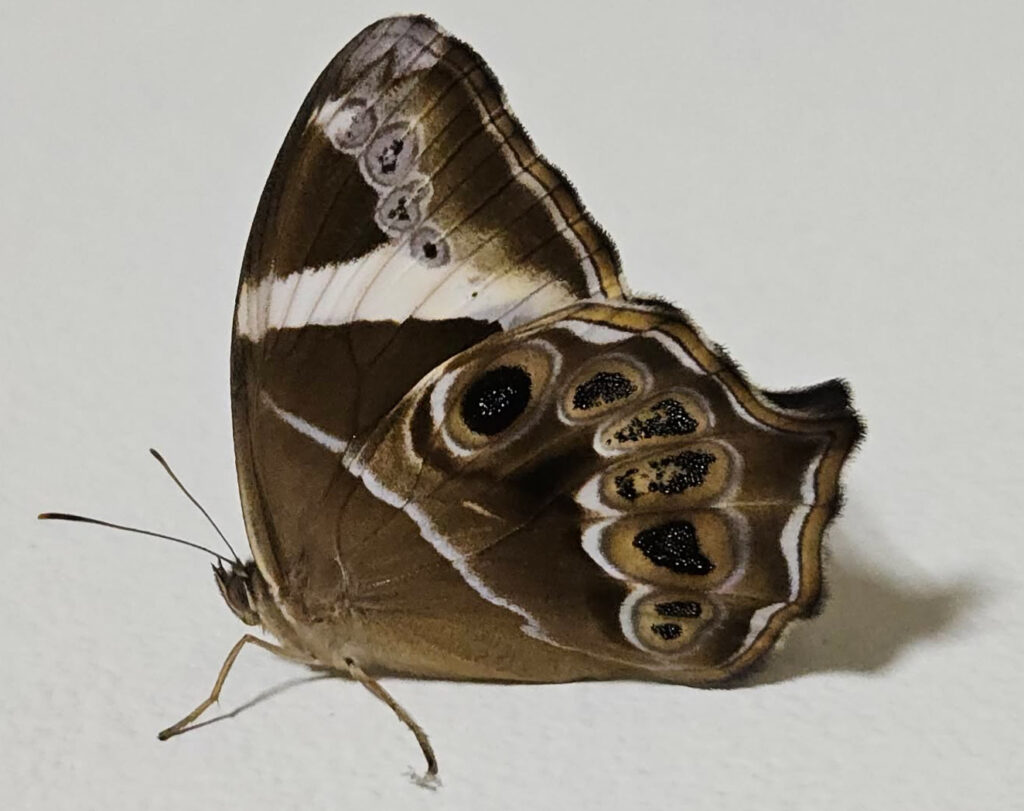
Als ich spät in der Nacht nach Hause ging, sah ich zwei Schmetterlinge an der Wand. Ich ging hin und machte ein Foto von ihnen. Der kleine war sehr brav und flog nicht weg. Der große hat mich erschreckt. Als ich nah genug war, flog er plötzlich los. Ich hatte Angst, dass er auf mich fliegt, und er hatte Angst, dass ich ihn fange.
Als ich spät in der Nacht nach Hause ging, sah ich zwei Schmetterlinge an der Wand.
Sentence 1: Late at night on my way home from work, I saw two butterflies on the wall.
This is a subordinate clause + main clause structure, introduced by Als (when, used for a one-time event in the past). Because the subordinate clause comes first, the main clause verb sah must sit right after the comma, in second position (verb-second rule).
- spät in der Nacht: late at night.
- nach Hause ging: went home (gehen in past tense). In German, going home is the typical way to wrap up the action of getting off work.
- sah: saw (sehen in past tense).
- Schmetterlinge: butterflies (singular: der Schmetterling, plural adds -e).
- an der Wand: on the wall (an is a two-way preposition; for static location it takes dative, so die Wand becomes der Wand).
Ich ging hin und machte ein Foto von ihnen.
Sentence 2: I went over and took a photo of them.
Two parallel actions connected by und (and/then), both sharing the subject Ich.
- ging hin: went over / approached (past tense of the separable verb hingehen).
- machte ein Foto: took a photo (past tense of machen).
- von ihnen: of them (von always takes dative; here referring to the two butterflies).
Der kleine war sehr brav und flog nicht weg.
Sentence 3: The little one was very well-behaved and didn’t fly away.
Der kleine is a nominalized adjective (referring to the small butterfly). Since butterfly is masculine (der Schmetterling), the article Der is used.
- war: was (past tense of sein).
- sehr brav: very well-behaved / obedient.
- flog weg: flew away (past tense of the separable verb wegfliegen; infinitive fliegen).
Der große hat mich erschreckt. Als ich nah genug war, flog er plötzlich los.
Sentence 4: The big one startled me. When I got close enough, it suddenly took off.
The first clause uses the very colloquial Perfekt (present perfect): hat (auxiliary) + erschreckt (past participle). The second clause again uses Als… to introduce a temporal subordinate clause; the main clause verb flog sits right after the comma.
- erschreckt: startled / scared (infinitive erschrecken).
- nah genug: close enough.
- flog los: took off (past tense of separable verb losfliegen).
- plötzlich: suddenly.
- nah: close / near.
- genug: enough. Just like in English, genug follows the adjective, so “close enough” is nah genug.
Ich hatte Angst, dass er auf mich fliegt, und er hatte Angst, dass ich ihn fange.
Sentence 5: I was afraid it would fly onto me, and it was afraid I would catch it.
This sentence uses dass (that) to introduce noun clauses. Rule: the verb in a dass clause must be pushed all the way to the end (e.g., fliegt and fange at the end of their respective clauses).
- hatte Angst: was afraid (past tense of haben + Angst fear).
- auf mich: onto me (auf with directional movement takes accusative, so ich becomes mich).
- ihn: it / him (accusative pronoun referring to the masculine butterfly).
- fange: catch (infinitive fangen).
Bis später! (See you later!)
Ich mache das später. (I’ll do this later.)
Später möchte ich nach Deutschland reisen. (Later I’d like to travel to Germany.)
Ich mache Feierabend. (I’m done for the day. / I’m calling it a day.)
Schönen Feierabend! (Have a good evening after work!)
Wann hast du Feierabend? (What time do you get off work?)
das Feierabendbier (after-work beer)
Leave a Reply